

Source – By Fr Edmund Power OSB
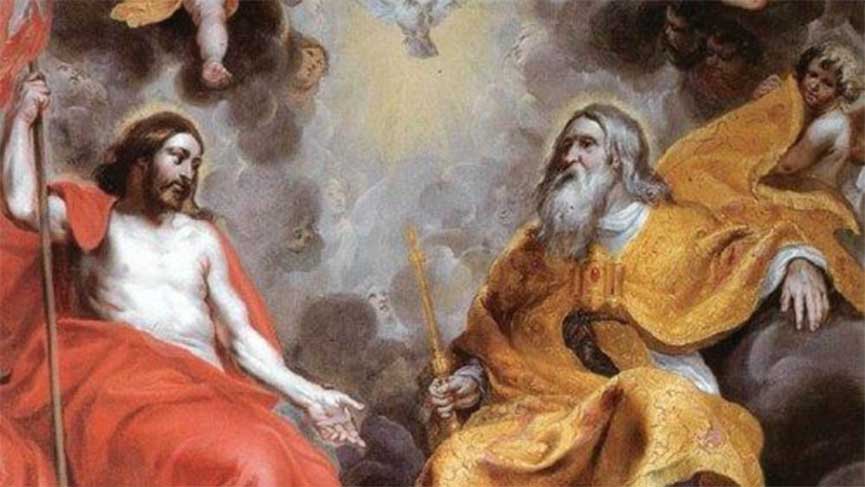
A nineteenth century hymn to the Trinity begins with the lines, “Most ancient of all mysteries, before thy throne we lie.” Surprising therefore that the most ancient mystery was approved for full liturgical celebration in the West only during the second millennium. But this does not mean that it was not, in various ways, venerated from the beginning. It could not be otherwise, given that it mysteriously permeates the Scriptures. Suffice it to note the reference to the divine wisdom from the book of Proverbs in the first reading of today’s Mass: I was beside him, like a master workman; and I was daily his delight. It could be a caption for the image on the sarcophagus.
Our very short gospel from the discourse of Jesus in the context of the Last Supper, provides yet another example of the relationship of love and intimate cooperation between Father, Son and Spirit, a love and cooperation that are constantly exercised in our favour. We see the sensitivity of Jesus to our limitations (you cannot bear them now), his great project to continue to guide us through the Holy Spirit (he will guide you into all the truth), and his unjealous desire to share with us what he and the Father share.
In the liturgy of the hours for this Solemnity, there is an antiphon which reads, “The Father is love, the Son is grace, the Holy Spirit is the one who unites, O blessed Trinity!” The purpose of this feast is not to give a lesson in dogmatic theology: we find, rather, an invitation to fall in adoration before the “most ancient of all mysteries” and to realise how much God, Father, Son and Spirit, draws us into the divine life.