
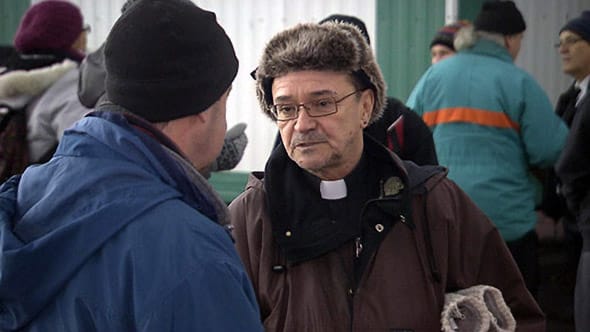
Notre-Dame de la rue (Our Lady of the Street) reaches out to people experiencing homelessness. It is a presence of the Church and a source of comfort. Since its founding in 2013, Father Claude Paradis and his assistant Kevin, together with volunteers, go out into the streets several times a week. They meet people where they are. Their first concern: to offer a spiritual presence and help people find meaning in what they are living through.
The street, another Church
“I often say, and it’s true, the guys who are outside are locked outside. They can’t get in. They’re locked outside; there’s no place they’re allowed into. It’s the opposite of what you might think,” says Father Claude Paradis, founder and, for just over two years, head of Notre-Dame de la rue, a unique initiative in the city.
First, there is the great freedom enjoyed by this new diocesan organization. “It doesn’t cost much; the street is my office,” says Father Paradis. Then there is the kind of welcome, which differs from other homelessness services. Without questioning how essential their work is, he points out that it is not always easy for people to feel comfortable there.
“Sometimes centres will say: ‘We offer an unconditional welcome.’ Except you have to arrive at a certain time, that’s mandatory; you have to shower, that’s mandatory; you have to shave, that’s mandatory; you have to go to bed at a certain time, that’s mandatory. So it’s not really unconditional: it’s full of conditions,” he says.
In fact, according to him, many homeless people refuse to go into shelters even at -30 °C. “Outside, they feel free.” It is in the street that Father Paradis, his companion Kevin and a small team of volunteers take the time to reach out to people. On the program: handing out a little food, coffee and water, but above all, being present to people who often no longer have any self-esteem.
“What is your true hunger? What is the meaning of your life?” explains Father Paradis. He likes to compare this spiritual thirst with the Gospel of the “Last Judgment,” in the final pages of the Gospel of Matthew: “I was naked and you clothed me… I was hungry and you gave me food.”
“What does it mean, I was naked and you clothed me? What is your dignity as a human being? People are hungry to be someone for another person. People are hungry to be loved by another person,” he explains. “That’s what it is now, in 2016: it’s no longer only the literal meaning we need to bring. I was naked – that’s the whole dignity of the human person. That’s worth a lot more than handing out a T-shirt in the street,” he says.
My parish is the street!
Can spiritual thirst only be satisfied in the comfort of a retirement home or a tidy church? While these are no doubt perfect places for it, they are not accessible to the people Father Paradis and Kevin accompany. “What saddens Pope Francis most about the clergy, in his apostolic exhortation The Joy of the Gospel, is the lack of spiritual care for the poor,” he points out – a message the Argentine pope addresses especially to the clergy. “It’s a big problem,” says Father Paradis, who hopes to help fill this gap through Notre-Dame de la rue.
“Everybody needs spirituality. That’s why we welcome them like this and take them as they are. We try to walk part of the road with them, at their own pace. If they don’t want to go to a centre, we’ll journey with them in another way.” Father Paradis notes that most of the people he meets have been “shuffled” from one foster family to another. For people in the street, going back to a centre also means dealing again with social workers, bureaucracy – the system, as they say. They have become distrustful after being let down so many times.
Finally, another thing that moves Father Paradis is that he sometimes hears the confessions of those he supports.
“Sometimes they don’t know it’s a confession, but they make one to me.” He has heard confessions in parks, but also in a shooting gallery and a brothel. “They’re strange places,” he admits – yet he would not trade places for anything in the world.
“Sometimes priests ask me: how do you do it? And I tell them, how do you manage to be in a parish? I couldn’t be in a parish. I just couldn’t.” His parish is the street. “I often say: I’m a former drug addict and I was on the street. It was the street that brought me to the Church; as soon as I was ordained, the Church sent me back to the street. I often say, the street is my Church.”
Supporting the search for meaning
Together with Kevin, he forms a team that goes out, mostly in the evening, to meet those who will spend the night outdoors. With a few volunteers, the visits are sometimes brief: a look, a hello, a coffee or a juice. Silence offers a moment of respite in a life where asphalt, crowds and the whims of the weather are hardly friendly companions. And the people are not the same as before; forget the days of the “good old rubby” with a mickey of gin in his bag.
Today, the street is home to young people from good families as well as professionals who lost everything to gambling. Or people whom the health system has let down, especially those with fragile mental health. Not to mention those on whom drugs have the effect of a bomb. In recent years, overdoses have been on the rise. The main problem is that anything is being sold. Drugs are cut with cleaning products, solvents and so on. No one knows what the effects will be – explosive mixtures that even regular users can no longer detect.
With all these people, Father Paradis sometimes gets into deeper conversations in which the day’s sorrows – and sometimes its joys – are shared. A moment for a confidence or a confession, and the small team is off to another strategic spot: a warm-air vent from the underground city in winter, or a cool park in the stifling heat of summer. Metro stations too, where, depending on the mood and openness of the staff, a person can stay for a while sheltered from the elements, especially in winter. But don’t count on the downtown stations when there is a hockey game, a major show or another event. They get cleared out. Nothing must suggest that these people exist…
The key word: hope
Father Paradis makes no secret of it: he would love for his flock from the street to come and pray at Mass one day. But the primary goal is not to fill churches. If a person finds meaning in life and manages to get out of the street, so much the better – like the young man he ran into by chance at the Saint-Félicien Zoo. From the streets of Montreal to the ticket line with his partner and their two children: Father Paradis’s words and actions bear fruit. But they are not always as visible as in this example. Hope is the key word.
To continue his work, Father Paradis needs the support of his bishop and of Kevin, his indispensable companion, but also of volunteers who do not judge and do not seek first to convert. He needs people who offer an unconditional welcome. Then there is financial support. Donations help support the two pillars, Kevin and Father Claude, and also buy devotional items – a Notre-Dame-de-la-Rue medal that is very popular – as well as a little food and coffee. They do not replace the soup provided by other organizations. However, to listen to one’s own search for meaning, it is better to have eaten a little first.
Video clips and media
In 2012, Father Paradis spoke to us about homelessness, the reasons that led him to care for people in the street and what he does concretely to help them.
In the media

La Reine des Bières et Notre Dame de la Rue (in French)
Among the many inspiring volunteer stories unfolding within the Archdiocese of Montreal, the one we are sharing with you today is surprising, to say the least.
Contribute
Notre-Dame de la rue works in partnership with other organizations offering mutual aid and spiritual listening. Notre-Dame de la rue is always looking for volunteers and donations of non-perishable food.
To volunteer
Father Claude Paradis
Phone: 514 925-4348
Email: notredamedelarue@diocesemontreal.org
To make a donation
Donate by cheque
Make your cheque payable to
L’Archevêché de Montréal (Notre-Dame de la rue)
2000 Sherbrooke Street West
Montreal, QC H3H 1G4
Charitable registration number : 11887 6390 RR0001
Donate online
Whatever you did for one of the least of these brothers and sisters of mine, you did for me.
Mt 25:40